Blog › Body Fat
Why BMI Alone Doesn't Tell the Full Story
BMI is a starting point, not a verdict. Here's what the other four methods reveal that BMI misses — and why athletes, women, and older adults should be especially skeptical of a single number.

What BMI Actually Measures
Body Mass Index was developed in the 1830s by Belgian mathematician Adolphe Quetelet — not as a clinical tool, but as a population-level statistic. The formula is elegantly simple: weight in kilograms divided by height in meters squared. That simplicity is both its greatest strength and its most significant flaw.
BMI tells you how heavy you are relative to your height. It says nothing about what that weight is made of. A 90 kg person with 10% body fat and a 90 kg person with 35% body fat will have identical BMIs — but completely different health profiles.
"BMI is a useful screening tool at the population level, but a poor diagnostic tool at the individual level."
Three Groups BMI Systematically Misleads
1. Athletes and Muscular Individuals
Muscle is denser than fat. A highly trained athlete can carry 85 kg of almost pure lean mass and register as "overweight" or even "obese" on the BMI scale. The NFL is full of players classified as obese by BMI who have single-digit body fat percentages.
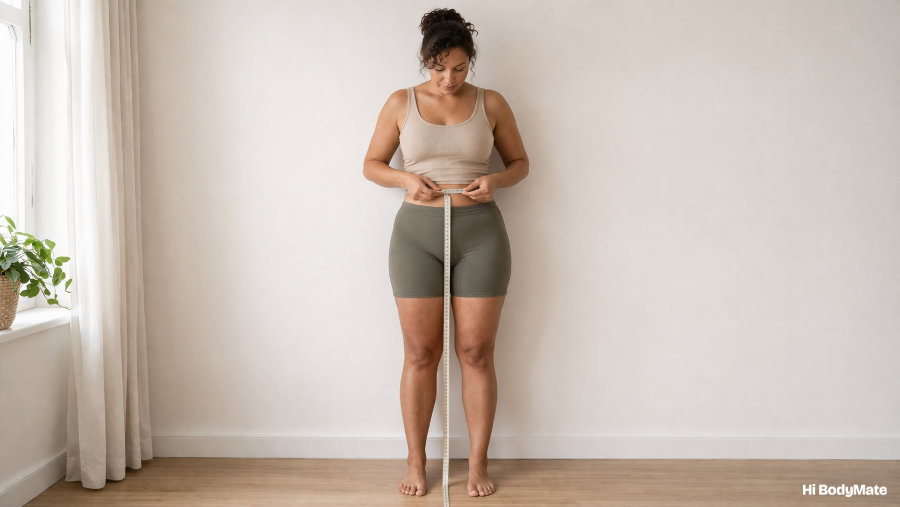
For this group, the US Navy Body Fat method is far more informative — it uses circumference measurements (neck, waist, hip) to estimate actual fat percentage, completely ignoring muscle mass.
2. Women
Women naturally carry 6–11% more body fat than men at the same BMI. A woman with a BMI of 22 (solidly "normal") may have a body fat percentage that clinically places her in the overweight range for her sex. Conversely, she may feel and perform better at a BMI that looks borderline on paper.
The Body Adiposity Index (BAI) was specifically designed to correct for this, using hip circumference and height to estimate fat percentage with sex-specific reference ranges built in.
3. Older Adults
As we age, we tend to lose muscle mass while gaining fat — a process called sarcopenic obesity. This can leave someone with a "healthy" BMI who is actually under-muscled and over-fat. Their weight looks fine on paper, but their metabolic risk is elevated.
Waist-based metrics like WHtR and WHR are particularly valuable here, since abdominal fat accumulation is both age-related and strongly linked to cardiovascular and metabolic risk.
See how your own numbers compare across all five methods.
Run all 5 calculators free →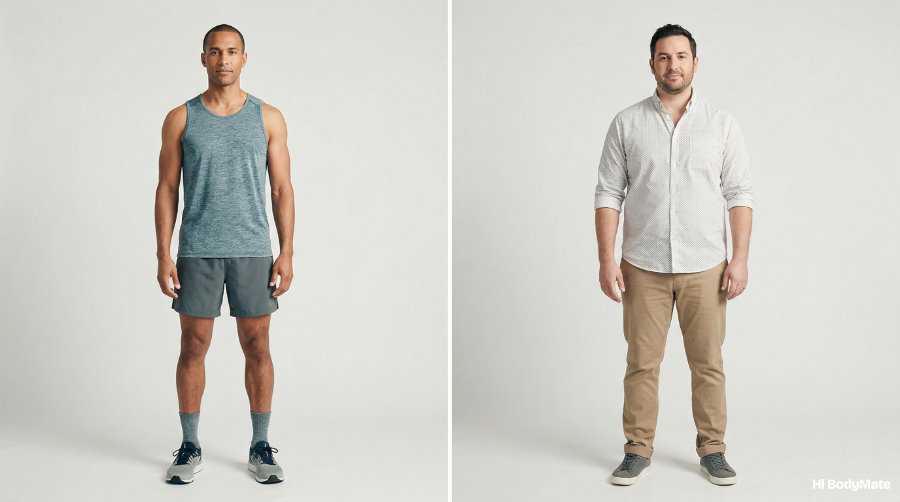
The Case for Using Multiple Methods
No single metric captures the full picture. Each of the five methods Hi BodyMate uses has a different angle:
- BMI — Quick population-level screening. Good for identifying extreme cases.
- US Navy Body Fat — Estimates actual fat percentage using circumference ratios. Military-validated.
- BAI — Hip-to-height ratio with sex-specific categories. Useful when a scale isn't available.
- WHtR — One simple rule: waist should be less than half your height. Strong cardiovascular risk predictor.
- WHR — Distinguishes fat distribution patterns (apple vs. pear shape), which matters for metabolic risk.
When most of these metrics point in the same direction, you can be reasonably confident in the signal. When they diverge — a normal BMI with a high WHR, for example — that tension is itself informative and worth discussing with a healthcare provider.
The Bottom Line
BMI is not useless. For most people who aren't highly trained athletes, it's a reasonable first filter. But it becomes meaningful only when you pair it with at least one or two other metrics that account for where your weight is distributed and what it's made of.
The best approach is to track your trend over time, use multiple methods consistently, and remember that no calculator replaces a conversation with your doctor.